

Hello world!
October 28, 2024
How to choose a web design company that fits your needs
October 23, 2026
A high rating is a useful signal, not a complete selection method. To find a web design agency in South Africa, compare its ratings with the substance of client feedback and its location relative to your business needs.
It’s reasonable to use reviews to narrow the field and location to assess practical fit. Neither tells you on its own whether an agency can build the website and digital infrastructure your business requires. This article explains how to interpret ratings, compare agencies across South Africa and weigh location alongside the work involved. You’ll have a clearer framework for turning a broad search into a focused shortlist, without treating a star score or a nearby address as a substitute for capability.
Key Takeaways
- Read the substance of client reviews, not just the star rating, to assess communication, delivery and the quality of completed work.
- Match an agency’s capabilities to your requirements, including website development, search visibility and user experience.
- Use location to judge practical collaboration needs, but weigh it alongside expertise and the project’s delivery requirements.
- Understand how scope, functionality, integrations and ongoing support shape a website project’s pricing before comparing proposals.
- Choose between an agency and a freelancer based on the breadth of expertise, coordination and capacity your project requires.
Agency review ratings
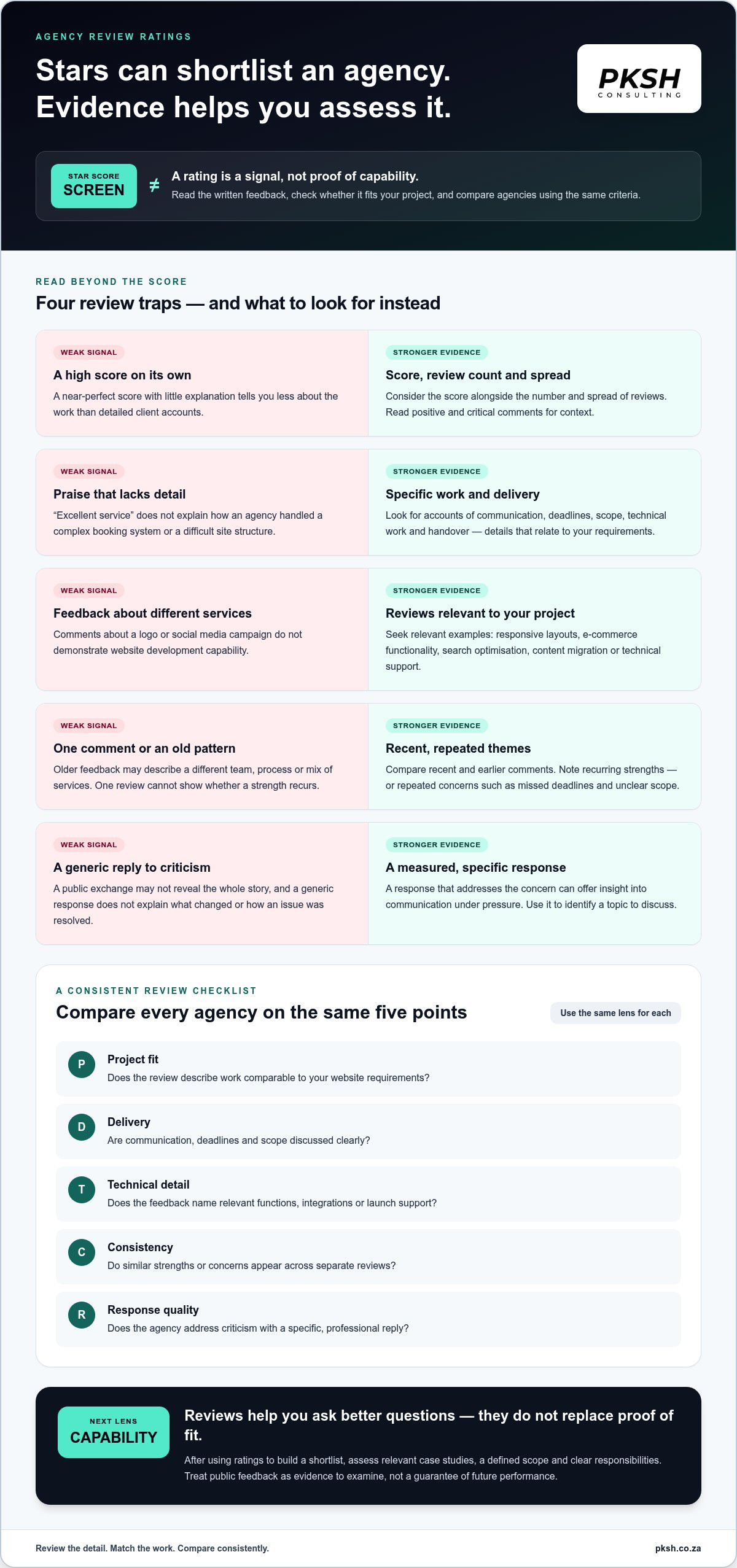
A star rating is a screening signal, not proof that an agency can deliver your project. On Google, compare written feedback with the score and look for details about the website, working relationship and handover. A review saying “excellent service” tells you less than one explaining how an agency handled a complex booking system or resolved a difficult site structure.
Assess the pattern of reviews rather than choosing the highest-rated name. Compare the score with the number and spread of reviews, then read both positive and critical comments. A strong average supported by detailed accounts gives you more context than a near-perfect score with little explanation. Reviews reflect individual experiences, so treat them as evidence to examine, not a guarantee of future performance.
Next, check whether the feedback is relevant. A web design agency in South Africa should have reviews related to the work you need. Comments about a logo or social media campaign don’t demonstrate website development capability. Look for accounts of responsive layouts, ecommerce functionality, search optimisation, content migration or technical support. For example, a retailer planning online sales should prioritise feedback about product catalogues and checkout implementation.
Recency offers another useful perspective. Older reviews may describe a different team, process or mix of services. Compare recent comments with earlier feedback and note whether the same strengths recur. If clients repeatedly mention clear updates, organised delivery and useful post-launch support, those themes can inform your assessment. Repeated comments about missed deadlines or unclear scope deserve attention if your project also involves coordinated technical work.
Read how the agency responds to criticism. A measured reply that addresses a specific concern can offer insight into how it handles communication under pressure. A generic response won’t explain what changed or how the issue was resolved. Don’t assume a public exchange reveals the whole story; use it to identify a topic to discuss during your selection process.
Use the same checklist for every agency. This helps ensure that a polished profile or memorable testimonial doesn’t outweigh more relevant evidence.
- Project fit: Does the review describe work comparable to your website requirements?
- Delivery: Are communication, deadlines and scope discussed clearly?
- Technical detail: Does feedback name relevant functions, integrations or launch support?
- Consistency: Do similar strengths or concerns appear across separate reviews?
- Response quality: Does the agency address criticism with a specific, professional reply?
Finally, distinguish reputation from capability. Reviews can help you ask better questions, but they can’t replace relevant case studies, a defined scope and clear responsibilities. When comparing a web design agency in South Africa, use ratings to build a shortlist, then assess each agency against the same criteria. That makes public feedback a practical screening tool, rather than a decision based on stars alone.
Looking for a top web design agency in South Africa?
Choose a South African web design agency by matching its capabilities to your objectives, then assessing relevant work, project controls and written terms. An online retailer, for example, needs more than attractive pages: it may also need product structures, checkout functionality, mobile layouts and search visibility.
Start with the outcome you need. A new business might need a clear information site, whilst an established company may need a redesign to support lead generation. Ask how the proposed work connects site structure, development, search engine optimisation and user experience. A coherent scope should show how each component supports the same business goal.
Consider technical delivery and user experience together. UX/UI means user experience and user interface: how visitors move through a site, and how its controls and visual elements look. For a booking business, assess whether visitors can understand the service, provide the required details and complete a booking. Responsive layouts should also work across phones, tablets and desktop screens.
For POPIA and ecommerce, identify the personal information collected, explain its use in clear privacy information and protect it through appropriate data-handling practices. An online shop should present product details, prices, delivery terms, returns information and payment steps clearly, so customers can understand the transaction before completing it.
A typical project moves through discovery, content and structure, design, development, testing and launch. The schedule depends on the site’s complexity, integrations, content readiness and pace of approvals. Agree milestones and review points before work begins, so decision-makers know what they need to provide at each stage.
A South African website quote or contract should define deliverables, exclusions, responsibilities, revision processes, milestones and handover arrangements. It should also clarify ownership, hosting, maintenance, payment terms and how additional work is handled. The price depends on the project’s scope, functionality, integrations and support requirements, and is provided after a quote request.
Compare proposals against identical requirements, not just headline descriptions. Check whether search-friendly structure is included and whether testing covers forms, mobile layouts and key user journeys. A proposal that identifies assumptions and dependencies gives you a clearer basis for assessing delivery than broad service labels.
For a project that needs joined-up planning and implementation, consider web design and development as part of your evaluation. A defined scope, practical milestones and clear ownership create a stronger foundation for comparing proposals and progressing towards launch.
South African web design agencies and their locations
Location can help you assess collaboration, but it doesn’t determine website quality. Compare nearby agencies with providers elsewhere in South Africa, then evaluate their project work and communication arrangements. An office nearby may make in-person workshops practical, but a defined remote process can also support delivery across the country.
Map the project’s coordination needs before weighing distance. If your team needs regular stakeholder sessions, decide which stages would benefit from face-to-face workshops. If decision-makers are based in different parts of South Africa, establish who attends each milestone and how decisions are recorded. Location matters when it affects the effort involved in coordinating people, content and approvals.
Search across South Africa rather than limiting your shortlist to a small radius. You can assess agencies based elsewhere in the country, provided their working arrangements suit the project. Treat an office address as a practical detail, not a measure of capability. Compare each agency against the same requirements, whether it’s nearby or works remotely.
For a local service business, location may influence how the website represents its operating area. A plumber serving several suburbs needs service-area pages and contact routes that reflect actual coverage. A consultancy working nationally may prioritise clear service information, enquiry handling and a consistent experience for visitors throughout the country. In both cases, site structure should reflect customer needs, not the agency’s address.
Before choosing an agency at a distance, agree on a practical collaboration model. Set expectations for project updates, feedback records, design approvals and time-sensitive decisions during working hours. For example, a shared feedback document and scheduled video reviews can keep work moving without repeated travel. In-person meetings are most useful when they help resolve complex decisions that are difficult to settle asynchronously.
- Compare travel needs: Identify which project stages genuinely benefit from face-to-face sessions.
- Define communication: Agree on meeting frequency, decision-makers and feedback tracking.
- Check relevant work: Review examples serving comparable customers or operating models.
- Assess coverage: Ensure the website reflects the areas your business actually serves.
Proximity doesn’t prove that an agency understands your audience. An agency based elsewhere in South Africa can build for customers across the country when research, search intent and service information shape the site. Ask how these factors will inform its structure. Then compare the proposed approach with your business footprint, rather than making assumptions based on the agency’s location.
Use location as one factor in a structured shortlist. Record each agency’s base, collaboration approach, relevant portfolio evidence and fit with your service area. This makes nearby and remote options easier to compare, while keeping your decision anchored to delivery requirements and business outcomes.
What factors affect web design pricing in South Africa?
Website pricing follows the work required, not simply the number of pages. A five-page brochure site with supplied copy differs from a five-page site requiring custom layouts, research and enquiry workflows. Compare quotes by deliverables and assumptions, rather than treating page count as a complete measure of effort. The price depends on the case and is given after a quote request; scope, functionality, integrations and support shape the quote.
Design and content requirements affect the production workload. A business with approved brand assets and finished copy can move into layout decisions sooner. A company needing content planning, page structure and tailored visual design requires more stages of input and review. For example, a professional services firm may need separate pages for each practice area, with distinct calls to action and supporting information.
Functionality adds another layer. A basic contact form has different requirements from an online catalogue with product filtering, customer accounts and payment processing. Integrations also affect the specification: a website connected to a booking platform or customer relationship management system needs clearly defined data flows and testing. List each required feature before requesting proposals, so agencies can price a comparable scope.
Technical work varies with the site’s architecture and existing systems. Migrating an established site may involve preserving page structures, redirecting old links and transferring content. A new build may need a different configuration, particularly if it must support multiple user roles or business locations. Specify the platforms the website must connect to, along with any legacy systems that need to remain operational.
Include search visibility and usability in your assessment of the build scope. A quote may include search-friendly page structure, metadata, mobile layouts and testing of key user journeys, or treat these as separate work. For a South African business serving several regions, clarify whether location-specific pages and navigation are included. A low initial figure may exclude tasks needed for launch or ongoing upkeep.
- Scope: Record page types, content responsibilities and required features.
- Design: Define whether layouts use an existing framework or require custom design.
- Integrations: Name each booking, payment or customer system the site must connect to.
- Reviews: Set approval stages, decision-makers and how changes are assessed.
- Support: Separate launch work from hosting, maintenance and future development.
Review the quote’s exclusions as carefully as its deliverables. Clarify how additional requests, revisions, third-party services and post-launch support are handled. If one proposal includes content migration and another excludes it, the totals don’t represent the same work. A shared brief helps you compare the underlying scope and choose an approach that fits your operational needs.
How do South African web design agencies compare with freelancers?
The right choice depends on what your website needs. A freelancer may suit a defined task, such as building a straightforward portfolio site or updating an existing landing page. An agency may be a better fit for a project combining discovery, design, development, testing and search requirements. Compare the delivery model with your scope, rather than assuming either option is automatically superior.
A freelancer usually offers a direct working relationship with the person completing the agreed work. That can simplify feedback on a focused project, such as revising a service page or implementing a supplied design. However, one person has finite capacity across design, development and technical support. Confirm how the work will proceed if the scope expands or additional skills are needed.
An agency typically coordinates several roles or capabilities through a shared project structure. An ecommerce build, for example, may involve interface design, development, product content and checkout testing. Coordinated delivery can reduce the burden of managing separate specialists, provided responsibilities and decision-making are clear. An agency structure doesn’t remove the need for a defined scope, accountable project lead and documented approvals.
Use the project’s operational demands to compare the two models:
- Scope: A small, clearly specified change may suit an individual specialist; a multi-stage build may need coordinated roles.
- Skill mix: List required capabilities, such as responsive design, integrations, content migration and testing.
- Communication: Identify who owns updates, gathers feedback and resolves conflicting stakeholder decisions.
- Continuity: Establish how access, documentation and technical handover will work after launch.
For a local South African consultancy needing a compact information site, one experienced freelancer may provide a direct route from brief to build. A retailer integrating product listings, payment steps and stock workflows may need broader coordination. These examples describe different project structures, not a quality ranking. Assess each proposal by relevant work, practical capacity and its delivery plan.
Responsibilities also differ in practice. With a freelancer, you may need to coordinate copywriters, hosting support or other specialists yourself, depending on the agreement. An agency may manage more components under one project framework, but the contract must define exactly which tasks it owns. In either case, clarify who handles revisions, testing, launch access and post-launch fixes before work begins.
Compare proposals using the same brief and deliverables. Record who performs each task, who approves decisions and how changes are managed. If the project requires a coordinated website build, plan your web design and development project around its scope, integrations and ownership requirements. That makes the choice between an agency and freelancer a practical capacity decision, not a judgement based on labels.
Pksh Consulting: Web Design & Development
Pksh Consulting helps businesses turn website requirements into coordinated digital infrastructure through Web Design & Development. It’s a practical next step if you need a new website, a structured rebuild or a clearer connection between your site and your growth priorities.
For businesses focused on organic visibility, Authority-Based SEO can support the website’s search strategy. Google Maps & Local SEO is relevant when customers search for nearby services, whilst Google & Social PPC supports paid campaigns. The right combination depends on your objectives, audience and website scope, so define your commercial priorities before shaping the project.
If you’re ready to discuss your website requirements, contact Pksh Consulting.
Set your website project in motion
Turn your shortlist into a project brief. Define what the website must enable, who it needs to reach and which business systems it must support. This gives a web design agency in South Africa a clear basis for shaping the work around your operational priorities, rather than a generic list of features.
Pksh Consulting offers Web Design & Development, Authority-Based SEO and Google Maps & Local SEO. These services can help businesses align a website build with organic visibility and local discovery. Set out your objectives and requirements, then use the brief to start a focused discussion about the right project scope.
Contact Pksh Consulting to discuss your website requirements and next steps. A clearly defined project gives your business a stronger foundation for building its digital presence.
Frequently Asked Questions
What services do web design agencies in South Africa offer?
A web design agency in South Africa may combine planning, interface design, website development and search marketing. The scope depends on the business objective: a membership organisation might need account access and gated resources, whilst a trades business may prioritise service enquiries and clear contact routes. Some agencies also provide paid advertising or local search support. Define the required functions and platforms first, then compare how each proposed service contributes to the finished website.
Which web design agencies in South Africa are highly rated?
Highly rated agencies have reviews that consistently describe relevant project outcomes and professional delivery. There’s no universal ranking that identifies the best fit for every business. Build a shortlist by comparing recent review themes with portfolios that match your sector and requirements. For example, a business commissioning a multilingual catalogue should prioritise evidence of comparable content structures, rather than relying on praise for unrelated design work.
Do South African web design agencies include SEO, hosting, and maintenance?
SEO, hosting and maintenance may be separate services, so treat each as a distinct scope item. SEO can involve improving site structure and content for organic discovery; hosting keeps the website available online, whilst maintenance covers ongoing technical care. Pksh Consulting offers Authority-Based SEO and Google Maps & Local SEO. Define who manages hosting, updates, backups and post-launch changes in the project agreement.