

Web Design Agencies in South Africa: Compare Ratings and Locations
October 22, 2026
A strong portfolio alone doesn’t make an agency the right choice. Choosing a web design agency means assessing whether its communication, technical skills, relevant experience and project process fit your business objectives. Client testimonials and awards can provide useful evidence, but they matter most when they support a clear record of collaboration and problem-solving.
A website is a commercial asset, so consider how it will be planned, built and supported as your business evolves. This guide explains how to assess an agency’s communication, technical skills, specialisation, awards and client testimonials, then compare those signals against your needs. It also shows how to judge project processes and portfolios by the business problems they address, not appearance alone.
Key Takeaways
- Set clear project goals and agree how feedback, decisions and progress updates will be managed.
- Assess whether the agency can build a secure, responsive website that fits your technical requirements and can evolve with your business.
- Use relevant portfolio examples to judge how well the agency understands your industry, audience and commercial objectives.
- Compare project scope, process, costs and ongoing support before making your decision, rather than choosing on appearance alone.
- Look beyond awards and general praise: useful testimonials and case studies show how the agency collaborates and resolves challenges.
1. Communication expectations and stakeholder collaboration
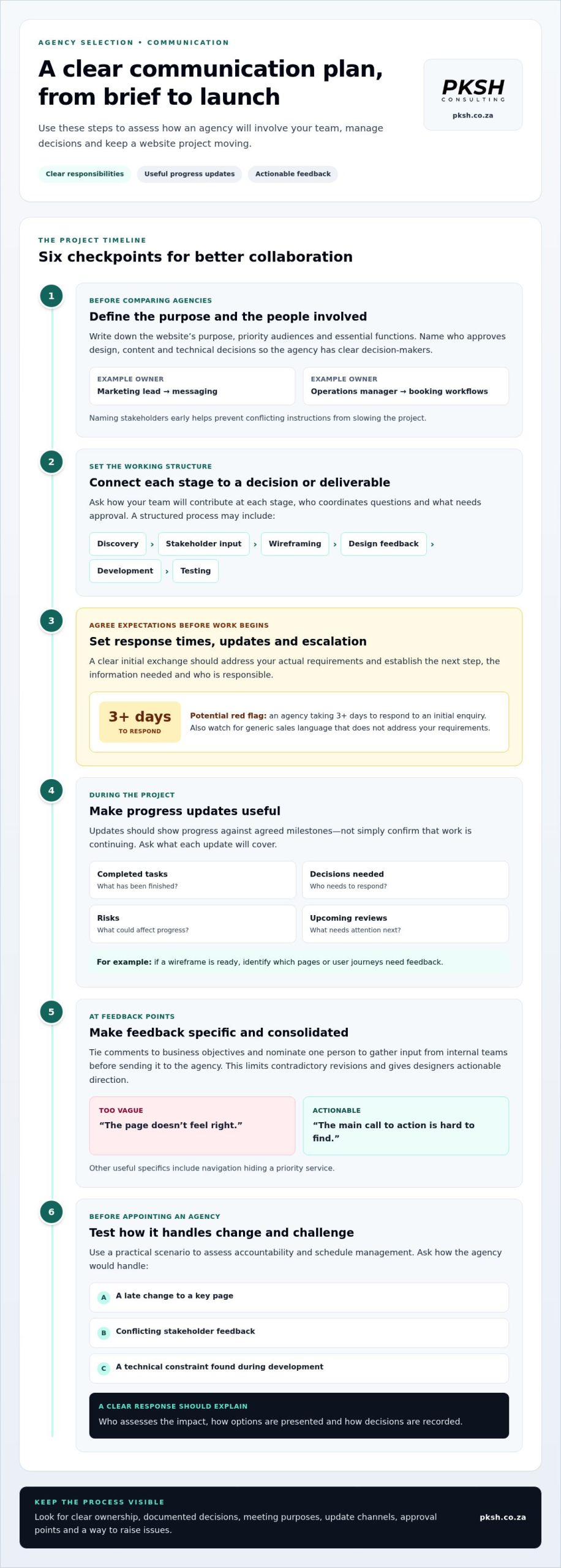
Before comparing agencies, write down the website’s purpose, priority audiences and essential functions. Identify who will approve design, content and technical decisions in your business. For example, a marketing lead may own messaging, while an operations manager approves booking workflows. Naming stakeholders early gives the agency clear decision-makers and helps prevent conflicting instructions from slowing the project.
Communication should link each project stage to a decision or deliverable. A structured process may include discovery, stakeholder input, wireframing, design feedback, development and testing. Ask how the agency will involve your team at each stage and who will coordinate questions. When choosing a web design agency, assess whether its proposed process makes responsibilities clear from concept through launch.
Agree expectations for response times, progress updates and escalation before work begins. An agency taking 3+ days to respond to an initial enquiry is a potential red flag. Also note whether its replies address your actual requirements or rely on generic sales language. A clear initial exchange should establish the next step, the information required and the person responsible.
Project updates should show progress against agreed milestones, not simply confirm that work is continuing. Ask what each update will cover, such as completed tasks, decisions needed, risks and upcoming reviews. If a wireframe is ready for feedback, the agency should identify which pages or user journeys need attention. This detail helps stakeholders respond promptly and prevents unresolved decisions from delaying development.
Feedback is most useful when it is specific, consolidated and tied to business objectives. Instead of saying a page “doesn’t feel right”, identify the issue: perhaps the main call to action is hard to find or the navigation hides a priority service. Nominate one person to gather comments from internal teams before sending them. This limits contradictory revisions and gives designers actionable direction.
Test the collaboration model with a practical scenario before appointing an agency. Ask how it would handle a late change to a key page, conflicting stakeholder feedback or a technical constraint found during development. The response should clarify who assesses the impact, how options are presented and how decisions are recorded. Vague answers make it harder to judge accountability and schedule management.
Look beyond slow replies for communication red flags. Watch for unclear project ownership, unexplained gaps in the process, missed follow-ups or reluctance to document decisions. A defined communication plan should set out meeting purposes, update channels, approval points and how to raise issues. Compare that plan with your team’s capacity so feedback stays timely and the project remains aligned through launch.
2. Technical skills, CMS platforms and website security
Start with your business goals, then translate them into website requirements. A services firm in South Africa may need enquiry forms and local service pages, while an online retailer needs product management, stock handling and secure checkout. Define the actions visitors should take, the content your team must manage and the systems the site needs to connect with.
Choose a content management system (CMS) that suits those requirements. WordPress may work well for a business publishing regular articles, while Shopify is built around online selling. Ask the agency to demonstrate how staff will edit pages, add products and manage user access. The platform should support your operating model, not force your team into a workflow it cannot maintain.
Assess development skills as well as visual design. The agency should explain how it will build functional, secure pages, test integrations and protect performance. Discuss how software updates, backups, access permissions and vulnerability handling fit into the project and post-launch plan. For example, an online booking form needs testing through its complete user journey, not just a visual review.
To address accessibility and POPIA, agree on measurable checks before development: test keyboard navigation, readable contrast, image descriptions and form labels. Review how personal information is collected, stored and accessed. Include privacy notices and data-handling processes in the project scope, with an appropriate South African privacy review before launch.
Navigation should help visitors reach priority information without unnecessary steps. For an online shop, test the category structure, product search, filters, basket and checkout on desktop and mobile. Ask the agency to map these journeys before development, then test them with realistic tasks. Clear paths reduce friction between finding a product and placing an order.
Mobile performance deserves direct assessment. Mobile devices account for over 55% of website traffic worldwide, so test key pages on a phone as well as a desktop. Check loading speed, readable text, tap-friendly controls and whether images or scripts delay the main content. Ask the agency how it measures performance and resolves bottlenecks.
Agree how success will be measured before launch. Choose indicators tied to your goals, such as completed enquiries, product purchases or visits to priority service pages. Confirm which analytics tools will track those actions and how often reports will guide improvements. A useful review links observed visitor behaviour to specific changes, rather than reporting traffic alone.
Agency services vary, so define the scope you need. Web design and development covers building the site, while SEO, hosting and maintenance may be separate services or arrangements. Confirm who handles each function, which deliverables are included and how ongoing updates will be managed. This helps prevent essential responsibilities from falling between teams.
For a project that needs connected website structure and growth planning, explore web design and development alongside your technical requirements. A defined scope lets you assess whether the proposed build can deliver the functions, performance and measurement your business needs.
3. Checking industry expertise and specialisation
An agency’s portfolio should demonstrate relevant problem-solving, not just polished screens. For a law firm in South Africa, examine how examples organise practice areas, explain services and guide visitors towards enquiries. For an online retailer, look for clear product categories and buying journeys. Review work across industries too, and assess whether each design reflects its own brand rather than repeating one template.
Ask what the agency contributed to each relevant project. A useful case study links the business objective to design decisions and the reported outcome. For example, if a service business wanted more qualified enquiries, look for changes to page structure, calls to action and mobile journeys. Visuals without explanation offer limited evidence of strategy or delivery.
Check how the agency approaches user experience across smartphones, tablets and desktops. Test portfolio examples on your own phone: can you read headings, use the navigation and find contact details without zooming? Review loading behaviour and tap targets as well. A well-designed user experience can increase conversion rates by up to 400%, so assess the journey as carefully as the visual style.
Industry specialisation matters when your business has distinctive requirements. An agency with hospitality experience, for instance, may understand how menus, bookings and location details influence visitor decisions. Compare that experience with your actual needs instead of treating a familiar industry label as proof of fit. Ask how the proposed structure would support your audience, services and commercial priorities.
Location can influence market understanding and collaboration, but it needn’t limit your search to a nearby agency. If your South African business serves customers across the country, assess whether the agency understands local search intent, regional terminology and how people find nearby services. Its Google Maps and local SEO approach should connect accurate business information with location-specific landing pages.
SEO expertise should be apparent before a site launches. Ask how keyword research will inform page structure, headings, metadata and content priorities. For example, a plumbing business serving multiple areas may need separate pages for its services and target areas, rather than one generic page. Check that mobile responsiveness and on-page optimisation are built into the project, not left until the final stages.
Use a consistent review process: select relevant portfolio projects, test their mobile experience, examine the agency’s role and assess its SEO approach. Then compare the evidence with your business requirements. A strong fit demonstrates technical capability and a clear understanding of how your website can attract the right visitors.
4. How do I choose a web design company?
Start with a brief that defines your vision, audience and business priorities. For an accounting firm in South Africa, the audience may need clear service explanations, practitioner details and a direct way to request assistance. Ask each agency to explain how its proposed site structure addresses those needs. This helps reveal whether it understands your business or is simply presenting a preferred design style.
Before hiring, ask who will lead the project, what each stage will deliver and how decisions will be documented. Clarify how the agency will measure conversion, manage scope changes and support the site after launch. Ask how it handles problems during a project, including what it learned from a previous setback.
Review the portfolio for projects relevant to your website type, then inspect the live pages on mobile and desktop. Look beyond colour and layout: assess navigation, calls to action and whether the structure solves a recognisable business problem. A case study is more useful when it explains the objective, the agency’s role and the outcome, rather than showing screenshots alone.
Assess reputation by seeking recent client feedback about communication, collaboration and problem-solving. References three or more years old may be a warning sign, as may missing or vague client information. Compare testimonials with named case studies, then look for consistent evidence of delivery instead of relying on general praise or a single award.
For SEO, ask how keyword research will shape page structure, on-page content and mobile optimisation. For Google AI Overviews, assess whether the agency plans clear, useful pages that answer specific audience needs and make key information easy to understand. Ask how it will track relevant search visibility and refine content. Treat a defined process as evidence of capability, not a promise of placement.
Compare proposals against the same scope: discovery, planning, design, development, testing and post-launch support. Ask each agency to explain its timeline, deliverables, exclusions and cost factors in writing. The lowest-cost option may not cover the full requirement. A detailed comparison can reveal gaps in scope before they become operational problems.
Apply the same criteria to every agency: audience understanding, relevant portfolio evidence, a structured process and clear accountability. Consider whether the agency’s values and working approach fit your business, then compare the evidence with your original brief. This turns choosing a web design agency into a disciplined assessment, not a decision based on visual preference alone.
5. Agency awards and client testimonials
An award can show that an agency’s work has received external recognition, but it doesn’t establish that the agency suits your project. Check the awarding organisation, category and work recognised. A design award may reflect visual craft, while your priority could be e-commerce functionality, accessible navigation or a clear enquiry journey. Treat recognition as supporting evidence, not a substitute for relevant project results.
Look for context behind each award. Identify the specific project and the agency’s contribution, then compare its requirements with your own. An award for a campaign website, for example, may reveal little about ongoing content management or a complex service catalogue. A credible portfolio should connect the recognised design to its intended audience and business purpose.
Read testimonials for detail, not adjectives. Comments such as “excellent service” offer little insight. Useful feedback explains how the agency handled a challenge, incorporated revisions or solved a delivery issue. A testimonial about a redesign might describe how stakeholders agreed on priorities and how the new structure addressed them. Look for evidence of collaboration and problem-solving relevant to your project.
Check whether testimonials clearly identify the client and project. Then compare their claims with published case studies, project pages or other reputation signals. Consistency matters: if a case study describes a complex build but the testimonial only praises its appearance, there is little evidence about delivery. References three or more years old may be a warning sign, so favour recent work when judging current practices.
Use client feedback to understand the working relationship. Look for examples of clear decision-making, constructive responses to feedback and coordination with internal teams. For instance, a client might describe how the agency resolved conflicting input from marketing and operations. This can help you assess whether collaboration will support your own approval process across design, content and development.
Find out what happened after launch. Testimonials and case studies may show whether an agency provided ongoing support, handled updates or helped a business respond to changing needs. Ask how those responsibilities were defined, especially if your website will need regular content changes or future redesign work. Evidence of post-launch care helps distinguish a completed build from a site designed for continued use.
Compare awards, testimonials and case studies as separate evidence. Awards show recognition; client accounts reveal working behaviour; project studies demonstrate context and outcomes. Give greater weight to specific, relevant examples than broad praise. If you’re ready to align a website project with your business priorities, discuss your website goals and the structure needed to support them.
Pksh Consulting: Web Design & Development
Pksh Consulting is a natural next step when your website needs to support clear business objectives, not simply present information. Its Web Design & Development combines custom development, considered website architecture and user experience, giving your project a foundation aligned with your requirements.
Turn to Pksh Consulting when you need a website built alongside a coherent approach to attracting relevant visitors. Authority-Based SEO supports organic visibility, while Google Maps & Local SEO addresses local search presence. Google & Social PPC can complement the site with paid advertising. The right mix depends on your goals, audience and project scope.
Share your priorities, required functionality and measures of success to start a focused conversation about the work. Contact Pksh Consulting to discuss your website project, or visit pksh.co.za.
Turn your website decision into a growth framework
The right choice should support more than the next launch. Treat your website as infrastructure that can adapt as your services, audience and commercial priorities change. This makes choosing a web design agency a decision about long-term alignment, not simply a design handover.
Pksh Consulting offers Web Design & Development, Authority-Based SEO and Google Maps & Local SEO. These services can align your website foundations with organic visibility and local discovery, creating a connected starting point for your digital growth priorities.
Define the business outcomes you want the website to support, then discuss the build and its wider role with a team equipped to address both. Contact Pksh Consulting today to discuss your website requirements and next steps. A clear brief is a strong basis for moving forward with purpose.
Frequently Asked Questions
How do I choose a web design company?
Choose an agency whose approach matches your business priorities, internal capacity and required website functions. When choosing a web design agency, compare proposals against the same brief, including integrations, content responsibilities and post-launch needs. Ask each team to explain the decisions and trade-offs in a relevant project. This shows how it handles constraints, not just how it presents finished work. Select the partner whose reasoning and scope best fit your operating needs.
Contracts and ownership: who really controls your website?
Your contract should define control of the domain, hosting account, CMS administrator access, website content and developed materials. Identify who can make changes and what happens to those assets if the relationship ends. For example, ensure your internal team has the credentials needed to manage essential accounts. Clarify whether third-party themes, plugins or fonts need separate licences, and document any transfer steps before work begins.
How long does a website project take?
A smaller website project may take 3-4 weeks, whilst a larger product or platform redesign can take 8-12 weeks or longer. The schedule depends on scope, integrations, content readiness and how quickly stakeholders approve decisions. For example, a late change to a payment workflow can affect development and testing. Ask for a milestone plan that shows dependencies, review points and what could move the launch date.
How much does it cost to hire a web design agency?
The cost depends on the project and is provided after a quote request. Strategy, content support, custom development, integrations and post-launch services can all affect the scope. A brochure-style site and a platform with booking or payment workflows require different work. Compare written proposals by deliverables, assumptions and exclusions, not headline totals alone. This helps establish whether each quote covers the same requirements.
Process: agile, waterfall, or hybrid?
Choose a process that fits how clearly you can define requirements and how often decisions may change. Waterfall sets stages and approvals in sequence, which can suit a tightly scoped site. Agile works through iterative delivery and regular review. A hybrid approach may fix core milestones while allowing selected features to evolve. Ask how changes are prioritised, approved and reflected in scope, so flexibility doesn’t obscure accountability.
What are the benefits of hiring a professional web design agency?
A professional agency can coordinate design, development and project management for a build that might otherwise involve separate suppliers. This is useful when your site needs custom functionality, input from several stakeholders or connections with existing business systems. For example, a booking website may need its enquiry journey, confirmation messages and reporting to work together. Define the required outcome and responsibilities so the team’s expertise addresses a real operational need.
What should I look for in a web design portfolio?
Look for projects with a similar purpose, complexity or audience, then inspect the working site rather than relying on screenshots. Test a complete user journey, such as finding a service, submitting an enquiry and receiving a clear confirmation. Check whether case studies explain the original challenge and the agency’s role. A portfolio should help you judge the thinking behind the work, not just its visual presentation.
What should I look for when choosing a web design agency?
Prioritise a clear scope, credible examples, accountable project ownership and a practical plan for post-launch changes. Check whether the proposed platform and integrations suit your team’s capabilities, not just the build requirements. Ask who will own key decisions and how unresolved issues will be escalated. A strong selection connects the agency’s working model to your business operations, reducing ambiguity before development begins.



1 Comment
[…] Choose a South African web design agency by matching its capabilities to your objectives, then assessing relevant work, project controls and written terms. An online retailer, for example, needs more than attractive pages: it may also need product structures, checkout functionality, mobile layouts and search visibility. […]